
Loading...
Serving Sugar Land, TX and surrounding areas. (281) 203-5105
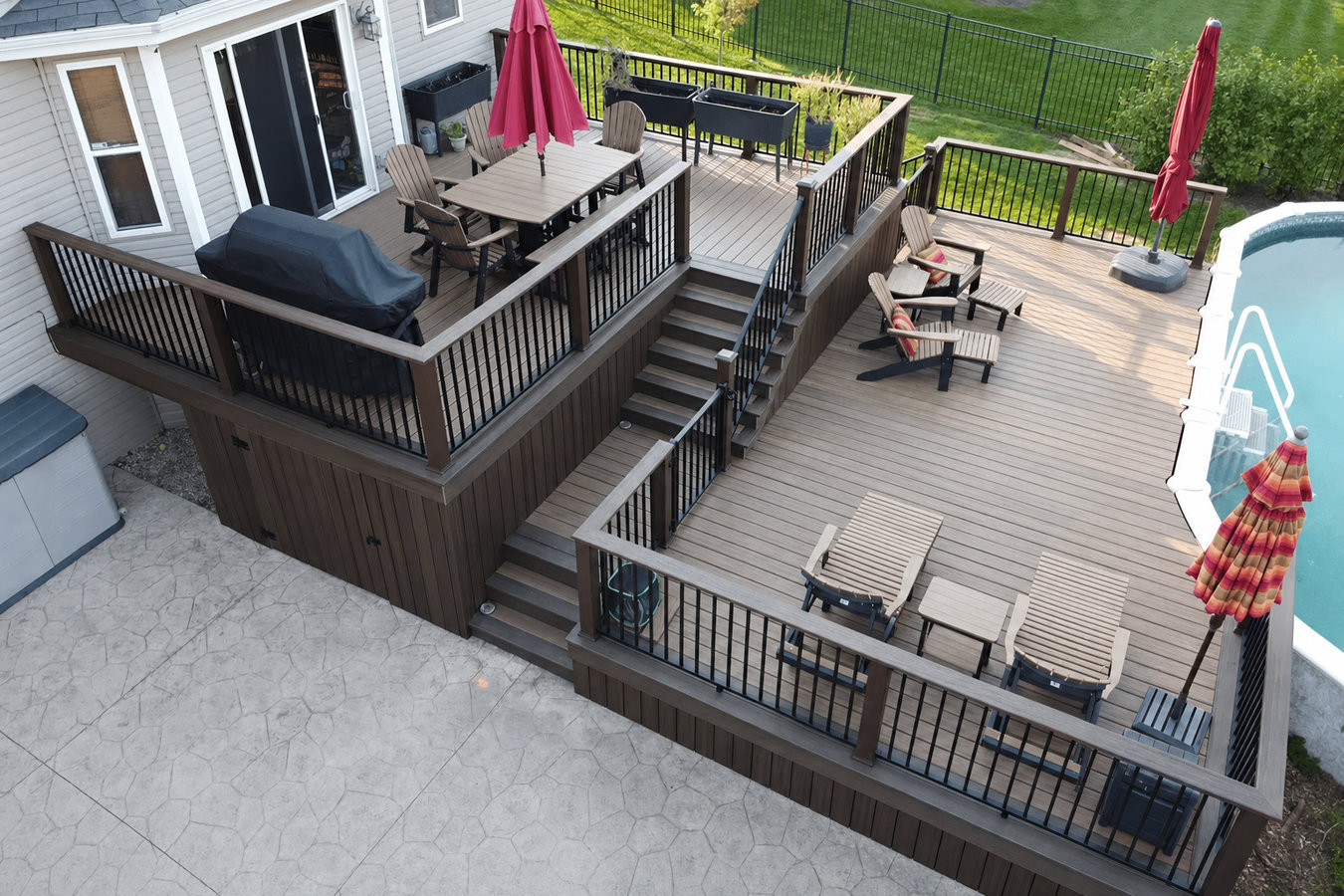
Turn a sloped, awkward yard into defined outdoor living areas. We build permitted multi-level decks with proper concrete footings for Fort Bend County clay soil, handle your HOA submission, and deliver a structure built to last through Sugar Land summers.
Multi-level deck construction in Sugar Land means building two or more connected platforms at different heights - anchored by concrete piers drilled below Fort Bend County's active clay layer, fully permitted through the City of Sugar Land, and designed to separate your outdoor zones so the space actually functions the way you want it to. Most two-level builds run one to three weeks of active construction once permits are in hand.
For Sugar Land homeowners, the typical driver is a yard that drops away from the back door - a common result of the grading done during subdivision development in Fort Bend County. A multi-level deck solves this cleanly: the upper platform sits at door height, the lower platform steps down to yard level, and stairs connect both. The result is usable outdoor space that a flat single-level deck cannot create on an uneven lot.
If you want safety and style to go together, our deck railing installation service handles all railing work for multi-level projects - from code-compliant balusters to cable and aluminum options. For homeowners looking to go further with their outdoor space, our custom deck design and build service covers fully designed projects from the first sketch to the final walkthrough.
If you step out your back door and immediately face a significant drop to the ground, you are losing usable outdoor space and creating a safety hazard every time someone steps outside. This is especially common in Sugar Land subdivisions where lots were graded during development, leaving the back of the house elevated above the lawn. A multi-level deck solves this by creating a platform at door height and stepping down gradually to yard level.
If your existing deck can barely fit a table and four chairs without blocking the door, you are not getting the outdoor living space your home could offer. A second level - even a modest one - can double your usable area and let you separate dining from lounging or grilling. Many Sugar Land homeowners in master-planned communities add a second level when their family grows or when they start entertaining more often.
Boards that curl upward at the edges, develop deep cracks along the grain, or turn weathered gray are telling you the surface has reached the end of its useful life. In Sugar Land's climate, this process happens faster than in drier parts of the country because of the combination of intense sun and frequent rain. If the framing underneath is still solid, a surface rebuild may be enough - but if posts and beams are also soft, a full replacement with a new multi-level design may be the smarter investment.
Many Sugar Land lots have a gentle or moderate slope that makes it hard to place furniture, play areas, or a garden without the ground feeling uneven. A multi-level deck turns that slope into an asset by creating defined, flat platforms at different heights - essentially terracing your outdoor space without touching the landscaping. If you find yourself avoiding your backyard because it feels awkward to use, a multi-level deck is often the most practical fix.
Every multi-level deck project starts with a site visit to measure the yard, assess the grade, check drainage, and identify any obstacles - utility lines, HVAC equipment, existing landscaping. We talk through your goals and your budget before putting anything on paper. Once we agree on a design, we handle the permit application with the City of Sugar Land Development Services and help you prepare the HOA submission if you live in a community with architectural review requirements. No work starts until all approvals are in hand.
Multi-level projects pair naturally with our deck railing installation service - every elevated platform needs a compliant railing, and we do that work as part of the same project. For homeowners who want the finished deck to match a specific vision, our custom deck design and build service handles full design-to-build projects with detailed plans before any construction begins.
Best for homeowners with a single-story step-down from the back door who want to separate a dining or grilling area from a lounging zone without major excavation.
Best for homeowners with a significant slope, a corner lot, or a large backyard where multiple distinct zones - cooking, seating, a hot tub pad - need their own defined platform.
Best for homeowners who want a deck that handles Sugar Land's heat and humidity with minimal yearly upkeep - composite boards resist warping, fading, and mildew better than wood in this climate.
Best for homeowners working with a tighter budget who are comfortable with periodic sealing and maintenance to keep the wood in good shape through Fort Bend County's wet seasons.
Sugar Land sits on Fort Bend County's expansive clay soil, which swells with moisture and shrinks during dry spells. That seasonal movement is one of the most common reasons multi-level decks fail early - posts set in shallow footings shift and lean as the ground moves beneath them. Building a multi-level deck here that stays plumb and solid through multiple wet and dry cycles means drilling concrete piers well below the active soil layer. We talk through footing depth on every estimate visit because in this area, the foundation is not a detail you can skip.
The permit and HOA process also adds real steps that homeowners in other parts of Texas may not encounter. The City of Sugar Land requires a building permit for attached and elevated decks, and the review typically takes one to two weeks. Many homeowners closer to Richmond and Rosenberg are also within master-planned communities where HOA approval runs on its own separate timeline. We handle both the city permit application and the HOA paperwork so you are not managing two approval processes on your own.
We reply within one business day. The first conversation covers your yard, your goals, and a rough sense of budget - no commitment, no pressure, and no charge. We schedule a site visit from there.
We visit your property, measure the space, check the grade, and look at drainage. We ask about your HOA requirements up front and give you a written estimate within a few days of the visit - so you know the full number before anything moves forward.
Once you sign, we submit the permit application to the City of Sugar Land and prepare your HOA submission if needed. Plan for one to three weeks for both approvals - this is normal and expected, not a sign that anything is wrong.
Construction typically runs one to three weeks. The city inspector visits once work is complete to confirm everything matches the approved plans. We do a full cleanup and walk you through the finished deck - pointing out maintenance steps and answering any questions - before you make a final payment.
Free on-site estimate. We handle permits and HOA paperwork. No work starts until every approval is in hand.
(281) 203-5105Every footing we set is drilled below the active clay layer that causes so much trouble for outdoor structures in this part of Texas. We ask about soil conditions on every site visit and spec the footings accordingly - not to the bare minimum allowed by code, but to what actually holds in Fort Bend County's seasonal soil movement. That detail is the difference between a deck that stays level and one that shifts after the first dry summer.
We handle the City of Sugar Land permit application from submission to inspection sign-off. If you live in a community with an HOA - including First Colony, Telfair, or Riverstone - we prepare the architectural review submission as well. You are not navigating two separate approval processes on your own. That is part of the job, not an add-on service.
Fort Bend County's mosquito pressure is a genuine concern, and a multi-level deck that traps standing water underneath is part of the problem. We design for drainage from the first site visit - proper grading, adequate clearance, and no low spots where water collects after heavy rain. The Fort Bend County Mosquito Control program actively monitors the area, and good deck drainage is the first line of defense.
Every project we take on comes with a written contract that spells out the scope, the materials, the permit timeline, and the total cost before work begins. A lot of Sugar Land homeowners have dealt with contractors who were vague about what was included - that is not how we operate. You know exactly what you are getting before a single footing is dug.
These credentials work together to give you a project that is predictable from estimate to final walkthrough. When the city inspector comes through, the work is already built to pass - because we design for the inspection from day one.
Code-compliant railings for every level of your deck - baluster, cable, aluminum, and composite options matched to Sugar Land's climate and your HOA requirements.
Learn MoreFully designed-to-your-specifications deck projects in Sugar Land, from first sketch through permit approval and construction completion.
Learn MorePermit timelines add two to four weeks before work can start. The sooner you call, the sooner your yard becomes the outdoor space you have been planning.